Towards Monosemanticity: Pulling Clean Features Out of a Messy Neuron
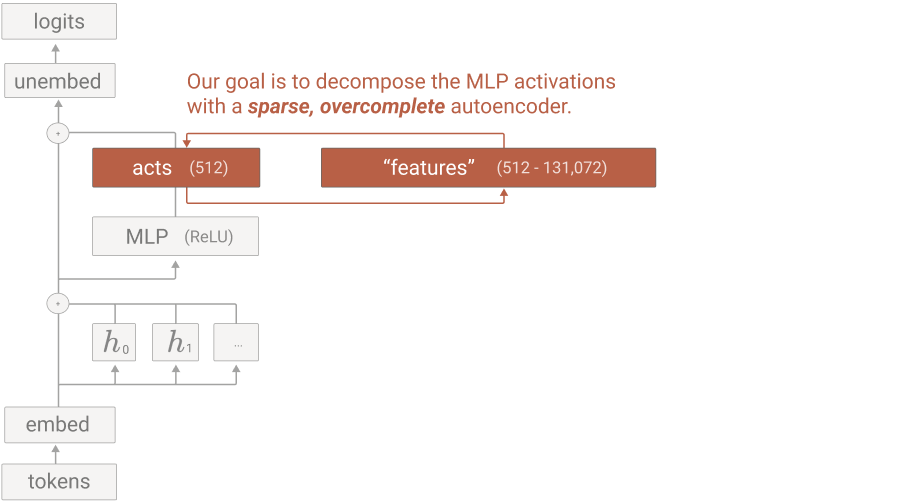
Inside a neural network, a single neuron fires for many unrelated things at once — it's polysemantic, which makes it almost impossible to read. So how do you pull out clean, single-meaning concepts? The 2023 paper "Towards Monosemanticity" showed the way, and it launched the whole feature-extraction program that later scaled to frontier models.
The method: dictionary learning
The trick is a sparse autoencoder (SAE). Take the model's tangled activations and re-express them in a much wider space where only a few units fire at once. By expanding the dimensionality and forcing sparsity, those units become clean, single-meaning features — the network's concepts, untangled from the neurons that superimpose them.
Formally, the SAE balances two terms — faithful reconstruction plus sparsity:
$$\mathcal{L} = \underbrace{\lVert x - \hat{x}\rVert_2^2}_{\text{reconstruction}} \;+\; \lambda\underbrace{\lVert f \rVert_1}_{\text{sparsity}}$$
Perfect reconstruction plus extreme sparsity is what isolates individual, human-readable features from the noise.
What a feature looks like
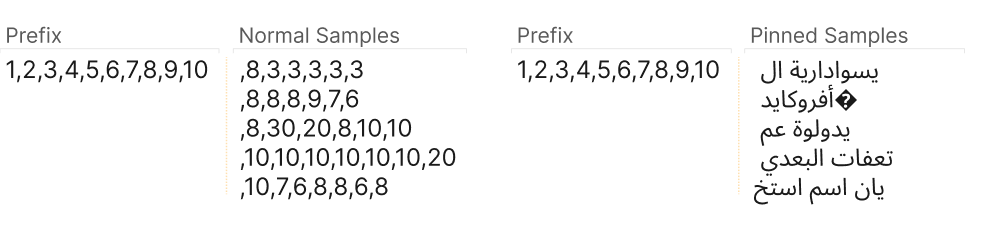
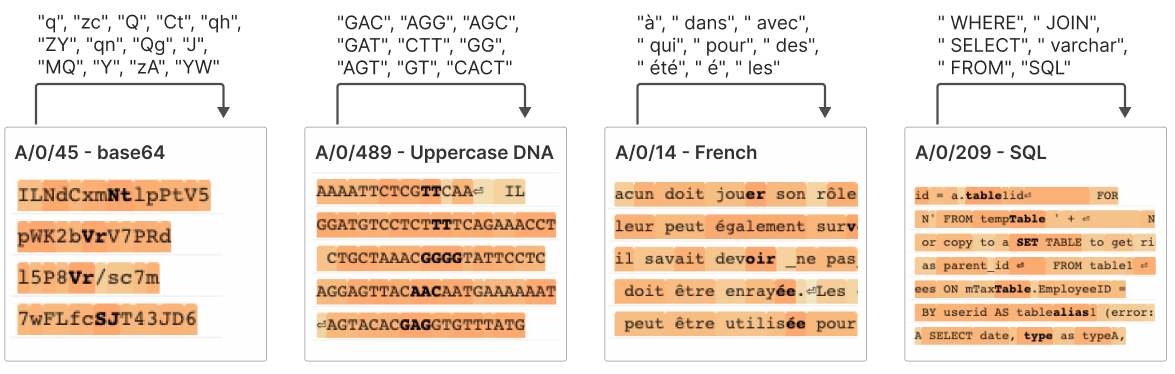
A good feature does two things: it fires consistently on one concept across many contexts (say, Arabic script, or DNA sequences), and when you turn it on, it steers the model's output toward that concept. Consistent and causal — far cleaner than any single neuron.
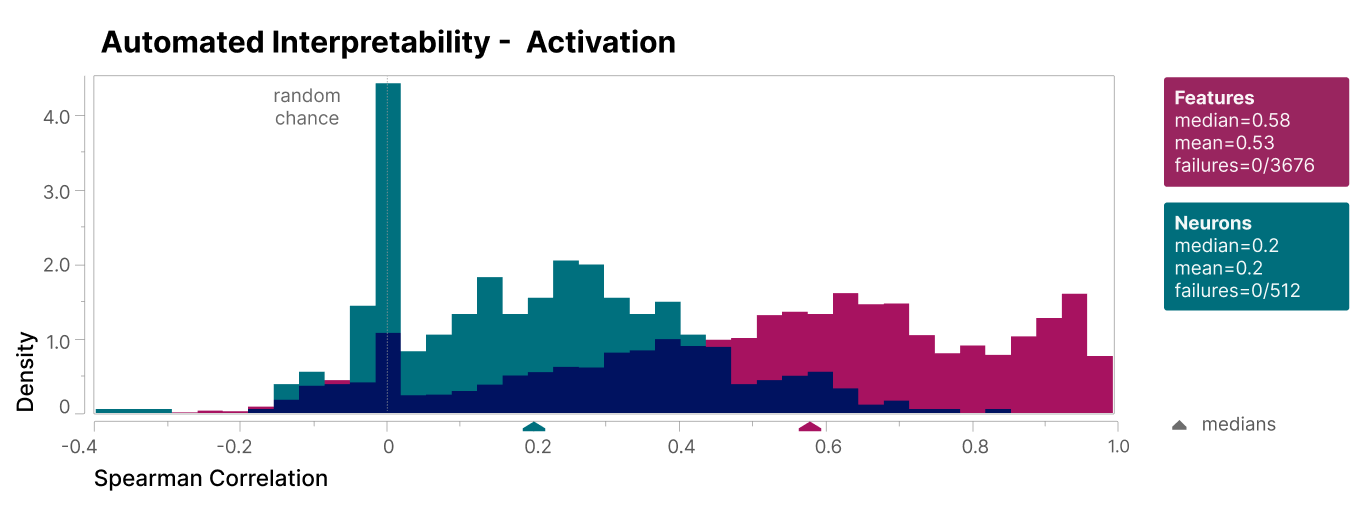
And this isn't hand-waving: scored for interpretability, the SAE features beat the raw neurons by a clear margin.
Feature splitting
A beautiful discovery: make the dictionary bigger and a single feature splits into many. One broad "bird" feature becomes features for specific birds; a generic concept resolves into finer ones. You can effectively zoom in on a concept at whatever resolution you choose — a hint that the model's concept space is richly hierarchical.
Why start so small — and why it mattered
The experiment ran on a deliberately tiny one-layer model, precisely so the result would be unambiguous. The same features even reappear across different models trained separately — strong evidence they're real structure in the data, not accidents of one network. That combination — clean, causal, measurable, and universal — is what made this the foundation for everything that followed, including extracting millions of features from a production-scale Claude.
The honest limits: an SAE is an approximation that captures only part of what a model represents, and choosing the dictionary size and sparsity is a real tuning problem. But this little experiment proved the core claim — that monosemantic features can be found — and turned reading a model's mind from a dream into a method.
Source: Bricken, Templeton et al., "Towards Monosemanticity: Decomposing Language Models With Dictionary Learning," Anthropic — Transformer Circuits Thread (2023). All figures © the authors, shown here for educational explanation.
Cite this post
Auto-generated. Verify for your institution's requirements.